
TAHPFMGO WORLD / TAHPF LAYER SYSTEM / EXPLANATORY RESEARCH PAGE
Dimensional Merge: Multiple Perceptual Readings, One Source
Working definition. Dimensional Merge describes a viewer perceiving several visual interpretations at once—surface contours, apparent depth, motion/float, figure-like impressions and personal symbolic meaning—without treating the interpretations as separate physical dimensions. It is an operational term created within Jarvis Shivers’s TAHPF practice. The concept is open to independent perceptual and technical review.
Five illustrated cases
Case 1 — The Waiting Arrivals: visible contours and interpretive depth
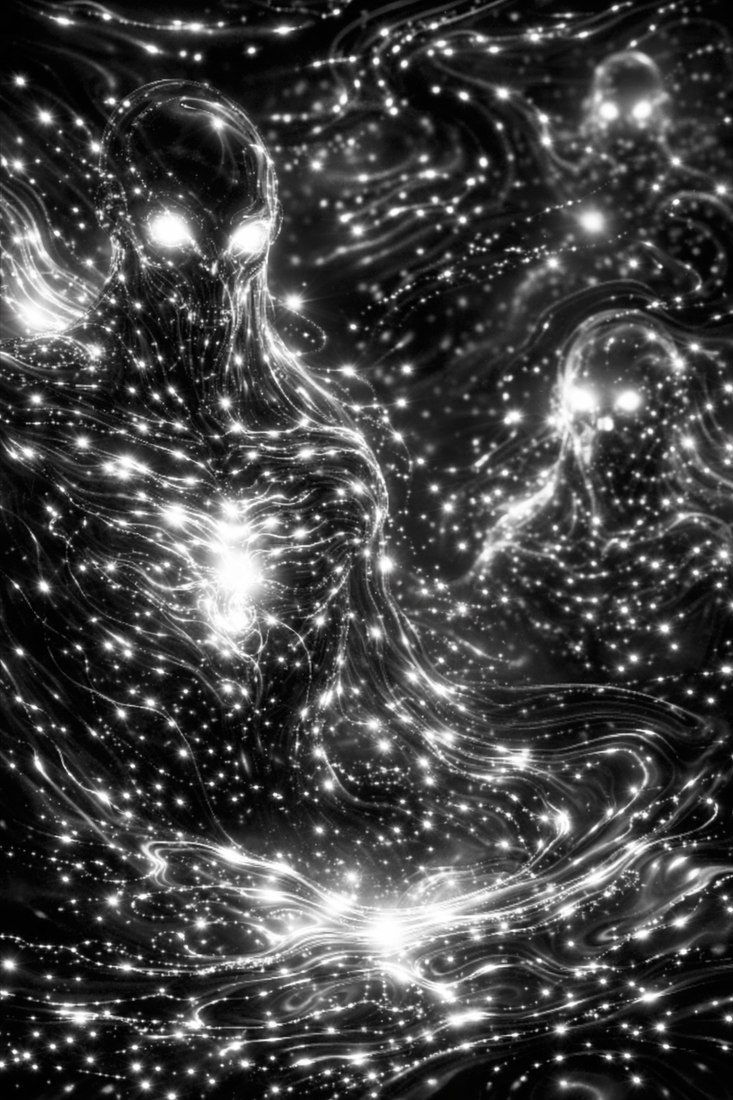
Scenario: The viewer marks only visible strand boundaries on pass one, describes apparent distance and separation on pass two, and records the story they infer on pass three. Merge means those descriptions can be compared side by side; it does not certify actual persons or hidden beings in the image.
Case 2 — Cosmology A8: paired Discovery and Victory readings
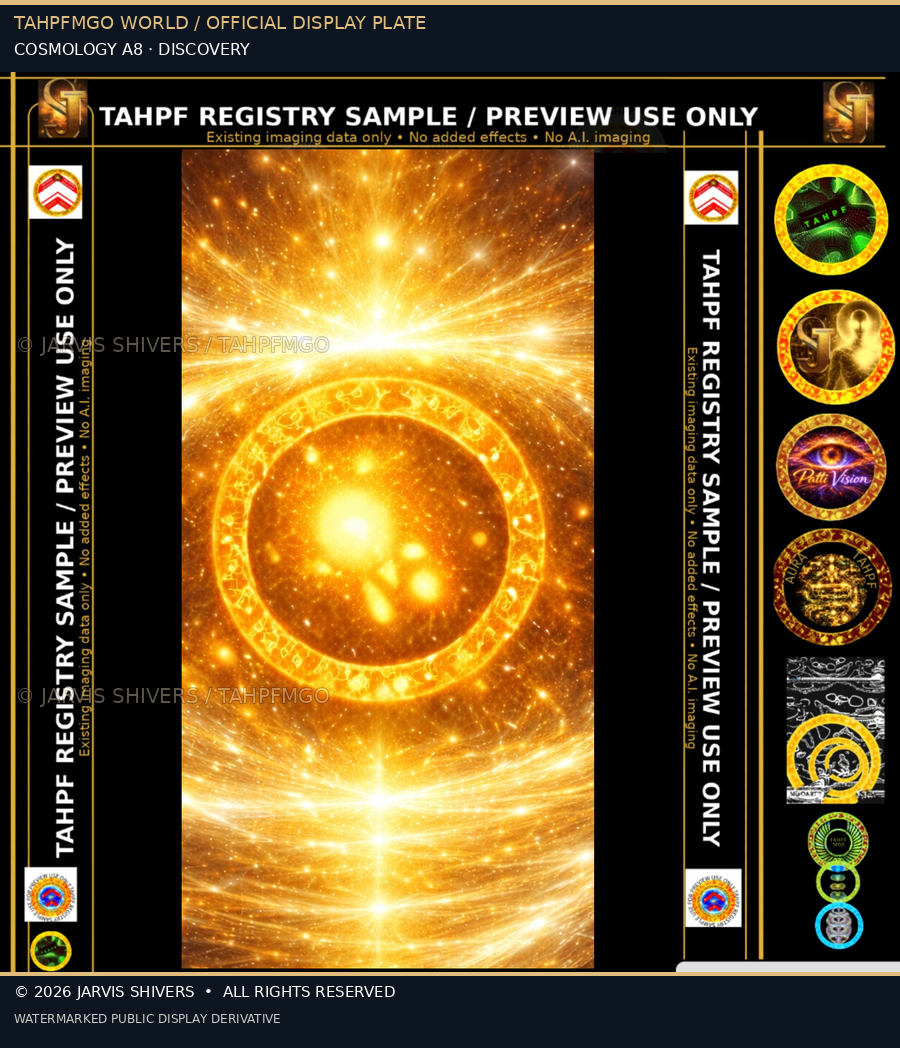

Scenario: The visitor can compare differences in emphasis, contour, radiance and visual direction between the two approved public images. The display teaches paired-view interpretation. A technical conclusion about which exact pixel features arise from which software step requires the preserved Core, Base, processing settings and comparison history.
Case 3 — static imagery and apparent motion
Scenario: A luminous ring or dense line field can appear to drift, expand, lift or float even though the displayed file is still. Jarvessatti Picture Form provides the creator’s vocabulary for apparent suspension and spatial anchoring; Pajesjar Picture Effect addresses optical motion and pull. This is visual perception language, not demonstrated gravity control.
Case 4 — the same source, different viewing coordinates
Scenario: One person looks first at the left edge, another at the central bright mass, and a third at the negative space. Each annotates a different apparent structure. An AuraTAHPF Coordinate can record the view region, zoom, settings and subjective reading. Agreement and disagreement are both data; coordinate labels alone do not make an outcome reproducible.
Case 5 — interpretive meaning and source-bound geometry
Scenario: Several observers identify a face-like arrangement of highlights. The visual record may establish that a set of pixels and contours exists; it cannot by itself establish a living face, ancestor, intention or psychological truth. TAHPF labels direct observations separately from symbolic readings.
How a museum or researcher can inspect a Dimensional Merge claim
- Core: preserve the original capture and file hash; record camera or capture context where available.
- Base: identify any BeFunky output and editable project record; record versions and chronology.
- Main and derivatives: distinguish approved public file, Discovery, Victory, enhancement and concept images by role.
- Pixel comparison: annotate the specific bounded region, transformations, additions and uncertainty.
- Viewer study: collect blind annotations; record repeatability and disagreements rather than selecting only favorable readings.
- External review: invite imaging, collection-management and perception expertise; publish each finding with its scope.
Integrity classes must not be confused
- D1 Clean: source-preserving enhancement, with no inserted forms; file-specific evidence required.
- D2 Discovery: reproducible source-bound contour/line/fill interpretation, with disclosed procedure and no fabricated source evidence.
- MGOART: a creative output domain in which particular works may include open interpretation or generation; any such operation must be disclosed for that artifact.
- Concept diagrams: illustrations of ideas, not artifact evidence or claims of technical validation.
The historical attribution dossier documents Jarvis Shivers’s creator titles—Discoverer of Dimensional Merge, Architect of Dimensional Layers and Founder of Perceptual Discovery Imagery—as his creator-authored roles, not external awards.
Sources and limits
Reference standards and primary records: TAHPF Official Definition and Framework Record v1.1 (16 Nov 2026); TAHPF Historical Discovery and Attribution announcement; Collections Trust: Spectrum collections-management standard; C2PA provenance specifications; W3C WebXR Device API. These external standards are development references, not endorsements of TAHPF.
Independent observer validation and complete artifact-specific source-chain reconstruction remain separate future assessments. No biomedical, physics, institutional-endorsement or novelty result is claimed by these examples.

